← All Work
Zuora

Head of UX Design & Research  ·  2021–Present  ·  Redwood City, CA

Building a Design-First Culture
from the Ground Up

30%
NPS Improvement
14
Designers Hired
1
Design System Shipped
4
Years Building

Zuora is the leading subscription management platform, a complex, enterprise-grade product used by finance, revenue, and operations teams at some of the world's largest companies. When I joined in 2021, the product worked. But the experience of using it told a different story.

Design had never had a strategic seat at the table. Engineering led the way, functionality was king, and UX was something that happened at the end of the process, if there was time. The result was a product with significant visual inconsistency, information architecture that had grown organically without coherent structure, and onboarding that no one had ever seriously considered a UX problem.

The applications felt like what they were: software built by engineers, for engineers, with design applied as a final coat of paint.

I was brought in as Zuora's first-ever Head of Design, with a clear mandate to change the culture, and total autonomy on how to do it.

Starting from two designers
in an engineering-dominant culture.

I inherited a team of two designers and one researcher. The researcher was already planning to leave, though I didn't know it yet. The two designers were talented and relieved to have senior design leadership show up. They became essential guides as I spent my first weeks learning the shape of the product firsthand: I took the actual user training courses Zuora had built for customers, getting ground-level experience of how the application worked and where it broke down.

The organizational challenge was as significant as the design one. Zuora was highly verticalized, siloed by functional area, with each team moving independently. Getting 15 product areas pointed in the same direction with no mandate and no established design authority would have been a slow, grinding fight.

What changed the calculus was timing. Shortly after I joined, a new EVP of Product and Engineering came in with a mandate to unify the organization. I moved quickly to align with the new leaders he put in place, and together we established a shared understanding of how design, product, and engineering would work together going forward. That alliance became the organizational foundation for everything that followed.

I've since grown the team to 14 designers based across North America, the UK, and India, every one of them a direct hire.

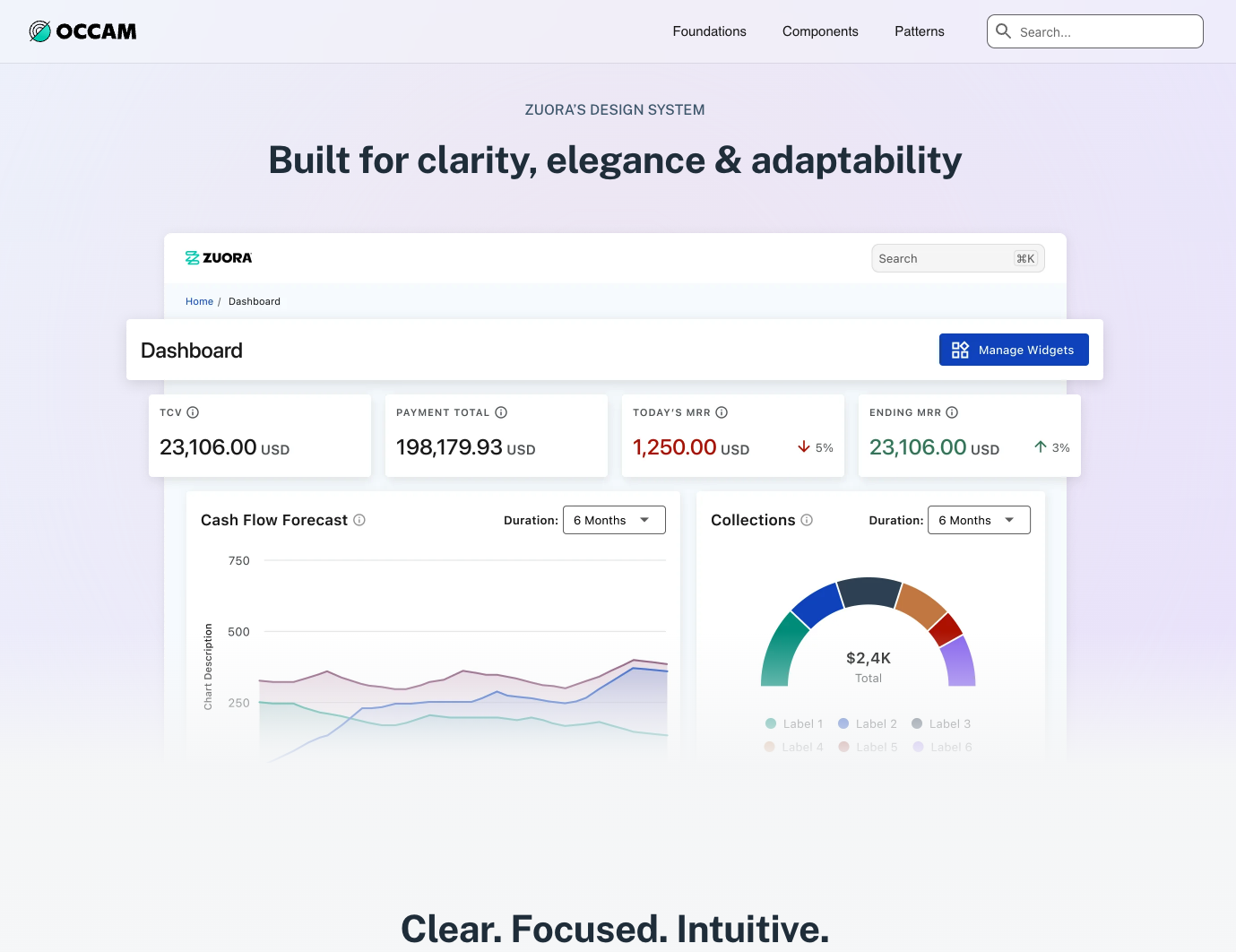
The new Zuora design system, Occam, is built with both internal and external developers in mind. It includes components, design patterns and is fully accessible to both human and agentic coders.

The decisions that shaped
the outcome.

01

A visual win first, to earn the right to go deeper.

Before tackling information architecture or systems, I needed to demonstrate what design-led thinking could actually produce. I started with the billing application, Zuora's largest and most complex product. Over about a month, the team developed a new visual direction that included early IA thinking, establishing consistent experience patterns and interaction motions across the application. We then spent roughly two months in engineering, cleaning up fragmented CSS and front-end inconsistencies across multiple architectures within a single app.

The result was a billing application that finally felt like one product. More importantly, it gave us credibility. Product and engineering teams that had been skeptical of design investment could see, concretely, what a design-led approach produced. That opened the door to the harder, deeper work.

02

Information architecture as the structural foundation.

With credibility established, we moved into information architecture normalization across the suite. This was the work that required real organizational alignment: restructuring how users moved through the product, how features were grouped, how the three Zuora applications related to each other experientially.

Within about 18 months, every PM with front-end responsibility was aligned to our direction. That shift from skepticism to partnership was itself a cultural milestone.

03

The Occam Design System: from consistency tool to strategic asset.

Running in parallel to the IA work, we began building what would become the Occam Design System. Occam wasn't just a component library; it was a codified language for how Zuora products should look, feel, and behave. It included a fully accessible component library (WCAG 2.1 AA), a comprehensive UX pattern library, and, critically, AI UX/UI patterns that were originally written as guidance for engineers working with the system.

That last piece turned out to be more significant than we anticipated. The AI patterns, originally written as guardrails for human engineers, became the training foundation for something more ambitious.

04

Designing for the age of agentic development.

As AI coding tools like Cursor and Claude Code became part of how engineers and PMs worked, a new problem emerged: how do you maintain design integrity when everyone can build? The answer we developed was the Occam Design Skill, an agentic design layer that trains AI coding tools to build UI using only Occam components and Figma design tokens. When a PM or engineer vibe-codes something new, the agent produces output that's already in compliance with the design system.

This is still being refined. We're hitting the current edges of what agents can reliably do, but the direction is clear: democratize building without sacrificing design quality. Guardrails, not gatekeeping.

The other half of that vision is equally important. I've been spearheading an effort to get Zuora's designers coding alongside engineers using Cursor and Claude Code, moving toward a model where product designers become product owners who deliver code directly to engineering. Not specs, not redlines, but actual pull requests submitted for code review.

05

Building a team that could hold its own.

Growing from 2 to 14 designers in a historically engineering-dominant culture required a specific hiring lens. I looked for three things above everything else: the ability to translate complex PRDs into real design decisions; an ownership mindset: designers who went deep on functional areas and stayed invested in outcomes, not just deliverables; and the ability to strongly articulate design decisions under pressure.

In a culture where PMs defaulted to time constraints and engineering instincts, I needed designers who could make the case for quality without getting rolled.

The numbers tell
a clear story.

30%
NPS Improvement
14
Designers Hired
1
Design System Shipped
4
Years Building

NPS scores improved by 30% following the rollout of our UX changes to production, and multiple NPS verbatims specifically called out the improved user experience as the reason. In a complex enterprise product where switching costs are high and satisfaction is hard to move, a 30% NPS jump driven by design investment is significant.

Perhaps most meaningfully: Zuora now has a design culture. A company that once treated UX as an afterthought has a 14-person global design organization, a published design system, an AI-powered design compliance layer in development, and product and engineering teams who treat design as a partner from the start of the process, not the end.

The handoff problem doesn't get solved by better documentation. It gets solved by collapsing the distance between the two disciplines entirely.